26.01.2026: BioRobot-MiniHeart Consortium Meeting Held in Ílhavo
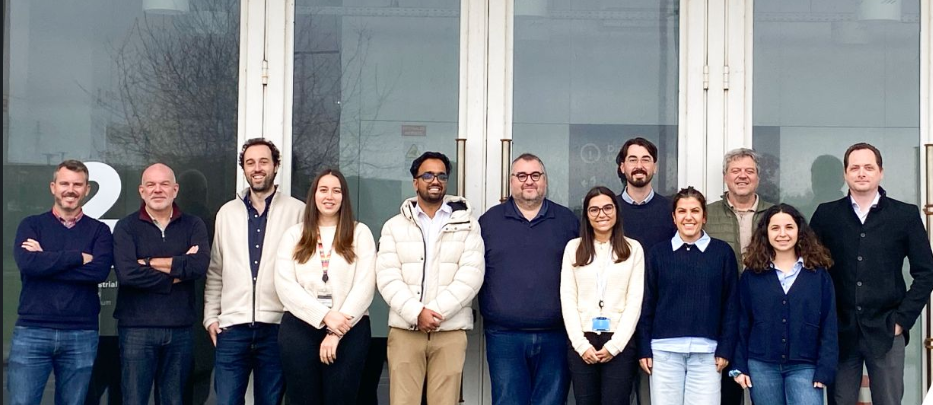
The BioRobot-MiniHeart consortium came together in Ílhavo, Portugal, for an in-person project exchange. The meeting provided an ideal setting to review the current status of the project and align the next development steps among the partners.
The focus was on the overall progress of the initiative as well as on expert discussions around key scientific and technological questions. The direct exchange on site supported the further development of the project’s content and strengthened collaboration within the consortium.
BioRobot-MiniHeart is carried out under the European Innovation Council’s EIC Pathfinder research funding programme. The project addresses new concepts at the interface of 3D-printed biological systems, biomedicine and nanotechnology.
17.11.2025: Showcasing Our MiniHeart in Action: A Human iPSC Heart Model in the Bioreactor
The MiniHeart demonstrates a technologically advanced human heart model that opens up new perspectives for research, drug development and biomedical testing systems.
A recent video shows the MiniHeart operating inside the bioreactor. The model actively pumps and moves the medium into the upper column of the system. This creates a dynamic, functional heart model capable of generating volumetric data. In the future, this data may provide valuable information for preclinical studies and drug development.
The MiniHeart is based on human induced pluripotent stem cells, known as iPSCs. By combining biological functionality with a technical measurement environment, the approach creates a new way to reproduce physiological processes more realistically and make them accessible for analytical applications.
The development highlights the potential of biohybrid systems for the next generation of biomedical research. It demonstrates how miniaturized living models can help improve the understanding of complex processes in the human heart and provide new tools for the drug discovery pipeline.
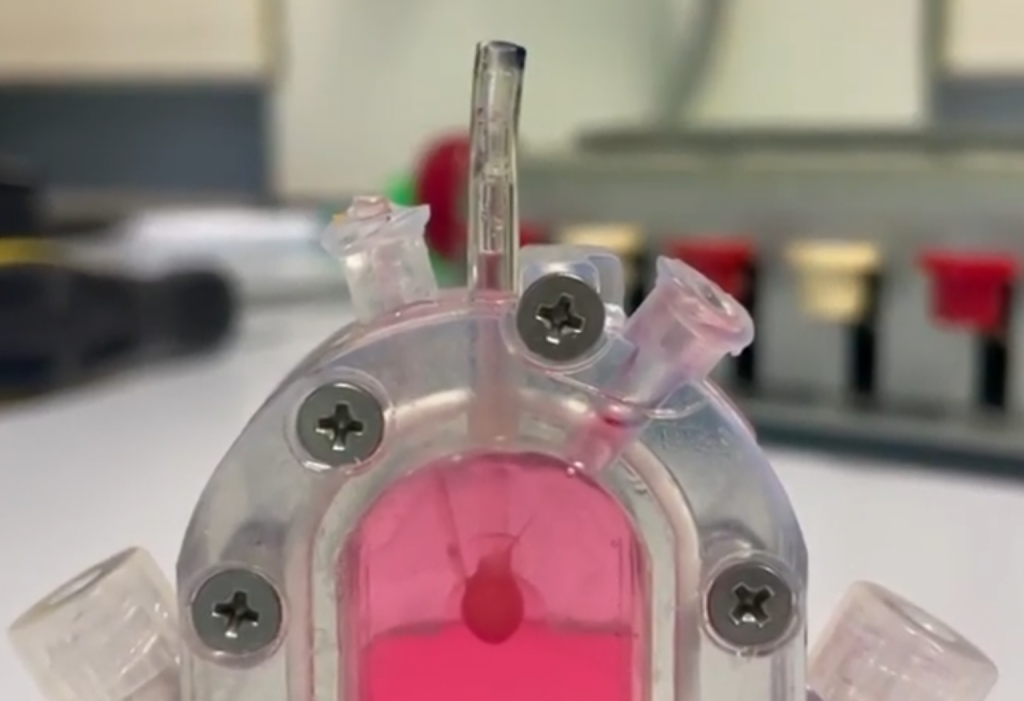
Watch the video: The video is available on YouTube.
BioRobot-MiniHeart is carried out under the European Innovation Council’s EIC Pathfinder research funding programme. The project addresses new concepts at the interface of 3D-printed biological systems, biomedicine and nanotechnology.

18.09.2024: Nanoss Participates in the ELM Portfolio Meeting in Saarbrücken
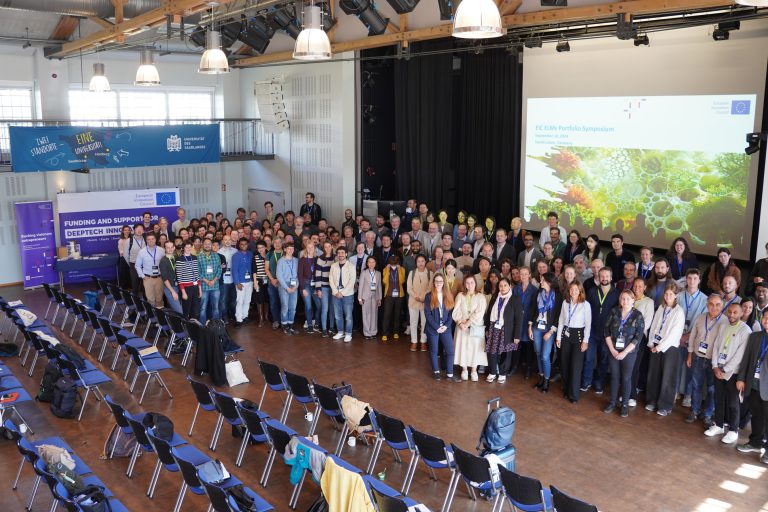
As part of the EIC ELMs Symposium, numerous experts from research, industry and technology development came together in Saarbrücken on 18 September to discuss current progress and future perspectives in the field of Engineered Living Materials.
Around 140 participants attended the symposium, including portfolio members on site and online as well as guests of the 4th International Conference on Engineered Living Materials. The event focused on project presentations, knowledge exchange, new approaches to collaboration and the question of how engineered living materials can be used in future research, medical and industrial applications.
Nanoss also participated in the meeting and contributed its technological perspective in the fields of miniaturized sensor technology, 3D nanoprinting and biohybrid measurement systems. For Nanoss, Engineered Living Materials are particularly relevant, as living functional material systems create new requirements for integrable, highly precise and biocompatible sensor solutions.
The Portfolio Meeting provided a valuable opportunity to present current developments, deepen scientific and technical discussions and further strengthen collaboration within the European ELM community.
The EIC ELMs Portfolio is an initiative of the European Innovation Council that connects European research and innovation projects in the field of Engineered Living Materials and promotes the development of controllably manufactured living materials with new functional properties.

05.01.2023: Nanoss develops miniaturized sensors for living biohybrid systems
Nanoss is expanding the scope of its 3D nanoprinting technology into a new generation of biohybrid systems. The development focuses on highly miniaturized measurement probes designed to capture key physiological parameters in engineered living materials.
The technological focus is on measuring minute pressure changes and dynamic volume movements in a 3D-printed biological heart model. Such systems place exceptional demands on sensors: they must be extremely compact, precise, biocompatible and integrated in a way that does not interfere with delicate biological processes.
Nanoss contributes its long-standing expertise in the fabrication of nanoscale sensor structures. By combining 3D nanoprinting, medical microsystems technology and application-oriented sensor integration, new tools are emerging for the analysis of living materials and complex biological function models.
“Engineered living systems open up entirely new perspectives for medicine, research and drug development. In order to understand and use such systems reliably, they require sensors whose miniaturization and precision can keep pace with the biological environment,” says Dr. Alexander Kaya, Managing Director of NanoScale Systems, Nanoss GmbH.
The development is supported by European research funding EIC Pathfinder – European Innovation Council and highlights Nanoss’ role as a technology partner for international innovation at the interface of nanotechnology, biomedicine and 3D-printed biological systems.
14.03.2022: Nanoss automates 3D nanoprinting for highly miniaturized nanosensors
Nanoss has achieved important progress in the automation of the 3D nanoprinting process for miniaturized nanosensors. The objective of this technological development is to make the fabrication of nanoscale sensor elements more reproducible, efficient and application-oriented.
The process development includes new measurement methods, optimized process parameters and more precise control of nanoscale structuring. This creates the basis for producing customer-specific sensors faster and with higher process reliability in the future.
For applications in medical technology, analytics, MEMS/NEMS systems and life sciences, this development is of particular importance. The smaller sensors become, the more important controlled fabrication processes, reproducible properties and reliable integration on different carrier materials become.
“Automation is a key step in moving 3D-printed nanosensors from highly specialized individual fabrication toward scalable application,” explains Dr. Alexander Kaya.
The work is supported by the German ZIM innovation funding program (Zentrales Innovationsprogramm Mittelstand) for small and medium-sized enterprises.
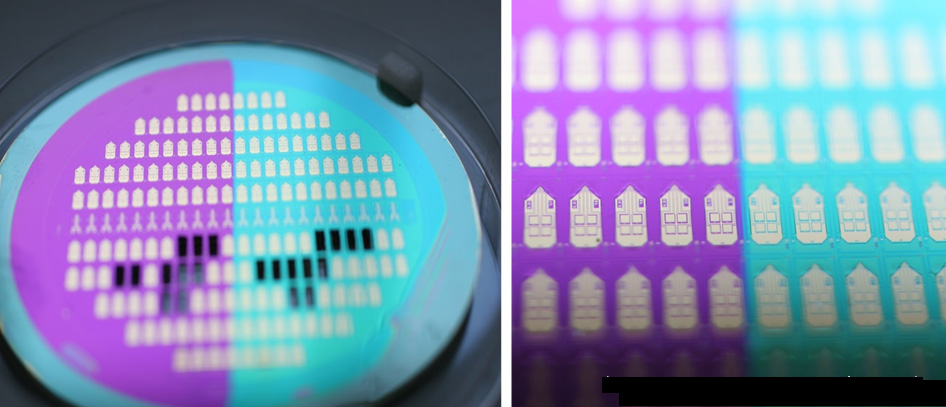
Segment of a wafer with MEMS/NEMS components for volume manufacturing using a 3D nanoprinting process
09.08.2021: Nanoss launches strategic collaboration in the development of novel diagnostic implants for the treatment of congestive heart failure (CHF)
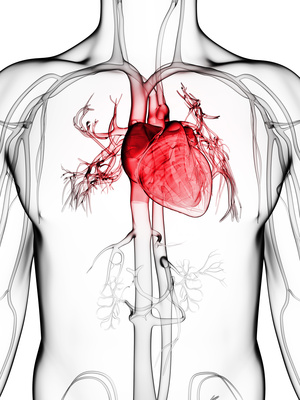
Nanoss has launched a strategic collaboration with international experts for the development of novel diagnostic implants and procedures for the treatment of heart failure patients.
In the course of the long-term joint development, which involves several interdisciplinary partners from industry, medicine and research, innovative technologies will be made available in the coming years that will combine home monitoring of the disease with new telemedical approaches and provide improved accompanying forms of therapy.
Dr. Alexander Kaya, CEO of NanoScale Systems, Nanoss GmbH said, “Congestive heart failure is the progressive weakening of the heart muscle that can occur due to a variety of causes, particularly heart attack, hypertension and myocarditis.”
Heart failure is characterized by high mortality, frequent hospitalizations and a significant impairment of quality of life. Nine million deaths in Europe alone are attributed to this disease each year.
“The ability to monitor certain vital data, such as intracardiac pressure, daily at home and assess them telemetrically under a physician’s supervision could provide early warning, often many weeks before acute heart failure (decompensation) becomes apparent”, Kaya said.
Current gold standard methods for accurate and routine assessment of intracardiac pressure often require multiple or repetitive invasive or surgical procedures (e.g., cardiac catheterization) and are associated with health risks for the patient. They are therefore unsuitable for daily use.
“We launched this novel development to overcome the serious drawbacks of current invasive monitoring techniques in terms of patient safety. Our mobile sensing and communication platform is designed to be implanted long-term using minimally invasive techniques and provide continuous real-time monitoring of intracardiac pressure and other hemodynamic vital data over several years. Using new manufacturing methods of microsystems engineering, nanotechnology and medically proven materials, we can further increase the miniaturization of the sensors while meeting the high physiological requirements of the sensors, such as small size, biocompatibility, durability and patient safety” Kaya added.
Continuous monitoring of blood pressure inside the heart is crucial for early prediction of heart failure. Based on reliable physiological data combined with proactive patient management, the consequences of the disease, if detected early enough, can be reduced and the likelihood of hospitalization reduced, as shown by numerous clinical studies from Europe and North America.
The development project, which is scheduled to run over several years, is funded by the German Federal Ministry of Education and Research (Bundesministerium für Bildung und Forschung (BMBF)).

4.11.2018: Nanoss evaluates a new implant concept for continuous intracardiac pressure measurement
Nanoss has evaluated the foundations for a novel long-term implant for continuous intracardiac pressure measurement in a European concept study. The development is aimed at patients with heart failure, for whom close monitoring of key vital parameters is of particular medical importance.
Continuous measurement of intracardiac pressure is considered a promising approach for detecting critical changes at an early stage. While conventional methods often require invasive procedures, miniaturized implantable sensors open up the prospect of gentler and long-term monitoring.
Nanoss contributed its expertise in 3D-printed nanosensors, miniaturized measurement systems and implantable medical technology. The aim was to assess technical feasibility, medical benefit and possible implementation pathways for a new sensor platform.
“A long-term implant for monitoring intracardiac pressure can make an important contribution to a more preventive and more personalized heart failure therapy,” says Dr. Alexander Kaya.
The concept study was supported by the European Horizon 2020 research and innovation program.

16.03.2017: Hessian Minister for Federal and European Affairs Lucia Puttrich talks with Nanoss GmbH about Hessen as a research location

Lucia Puttrich, Hessian Minister for Federal and European Affairs
Minister of State Lucia Puttrich spoke with NanoScale Systems, Nanoss GmbH on Thursday about the European funding program Horizon 2020. Among other things, the conversation focused on new methods for improving the treatment options for heart failure.
“Hessian innovations not only benefit the region, but also Germany and Europe in the long term,” said Lucia Puttrich during her visit to Darmstadt. The great innovative potential of small and medium-sized companies shows their great importance for Hessen as a location for research and development, she added.
Nanoss GmbH is developing extremely miniaturized sensors that will be used for continuous blood pressure measurement in the body and that place particularly high demands on minimal invasiveness, biocompatibility and energy efficiency.
Dr. Alexander Kaya, Managing Director NanoScale Systems, Nanoss GmbH said, “Sensors that provide long-term monitoring of vital life functions in the body have now been among the greatest unsolved challenges in medical technology for more than two decades. Only by combining sophisticated technologies and bringing together multidisciplinary experts will true innovations be created that will provide patients with the best possible and most gentle therapy.
16.10.2016: Renowned publisher nature brings pathbreaking results on novel nano3DSense-sensors in September issue of “nature communications” journal
Renowned scientific publisher nature has released in its September issue of “nature communications” journal groundbreaking results on sub-micrometre force sensors for high-speed nanocharacterization and biosensing using novel 3D nanoprinting. Thanks to nano3DSense nanoprinting technology the smallest known and commercially available sensors for force and pressure measuring are provided that are now surpassing in terms of compactness, sensing speed and sensitivity.
Read article free of charge online on nature.com: “Direct-write nanoscale printing of nanogranular tunnelling strain sensors for sub-micrometre cantilevers”
(Nature Communications 7, Article number: 12487 (2016))
24.02.2016: Nanoss develops novel nanosensor technology for detecting extremely low mercury concentrations
Nanoss GmbH receives German BMBF funding (“Bundesministerium für Bildung und Forschung”) for its next generation gas sensors based on the novel nano3DSense 3D Nanoprinting Technology
Nanoss has advanced the development of highly sensitive sensor principles for personal mercury monitoring. The focus is on detecting mercury vapor at very low concentrations in order to better protect people in potentially contaminated environments.
Mercury is considered a particularly critical hazardous substance. Early and reliable detection of even the smallest concentrations can make an important contribution to health protection in working environments, industrial processes and safety-relevant applications.
For this purpose, Nanoss investigated nanogranular and nanoporous materials as the basis for a new generation of sensors. These materials offer special potential because their electrical and structural properties can respond to even the smallest chemical changes.
The development demonstrates that nano3DSense technology is relevant not only for force, pressure and strain measurement, but can also open up new approaches in chemical sensing and the detection of critical substances.
The work was funded by the German Federal Ministry of Education and Research, Bundesministerium für Bildung und Forschung (BMBF).
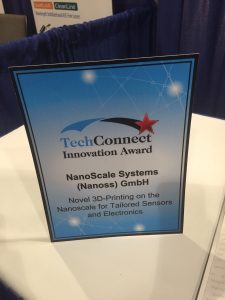
21.06.2015: TechConnect Innovation Award goes to Nanoss GmbH for highly customizable sensors
TechConnect World Innovation Conference & Expo 2015, June 14-17, 2015, Washington, DC
Nanoss GmbH receives the renowned TechConnect Innovation Award 2015 for “Novel 3D-Printing on the Nanoscale for Tailored Sensors and Electronics”, Washington, DC

Selected & Presented at TechConnect World Innovation Conference
12.02.2015: Nanoss GmbH at TechConnect World Innovation Conference & Expo, Washington, DC, June 14-17
Nanoss GmbH at the TechConnect World Innovation Conference:
Talk at Biotech, Medical & Pharma Session: Innovation Spotlights: Medical Devices
Selected & Presented at TechConnect World Innovation Conference
04.03.2015: Nanoss GmbH at HANNOVER MESSE, Germany, April 13-17
Download our new company profile (both in English and German) “Neue Werkstoffe, Nanotechnologie – Made in Germany” at HANNOVER MESSE 2015, Germany in cooperation with VDI (Verein Deutscher Ingenieure) and BMBF (Bundesministerium für Bildung und Forschung)


06.05.2014: Best Sensor Award 2014 for nano3DSense

Nanoss GmbH wins the ‘Best Sensor Award 2014’ of the renowned ‘Sensors’ magazine for ‘A Tunable Strain Sensor Using Nanogranular Metals’
www.mdpi.com/1424-8220/14/1/1898/pdf
21.10.2013: Nanoss GmbH starts the FP7 EU project FALCON for next generation sensors for highspeed atomic force microscopy (AFM)

Nanoss GmbH wins EU funding FALCON: Nanoss follows up on the successful EU project ALBICAN and starts the FP7 (7th Framework Programme) successor project FALCON for the market introduction phase of the next generation of self-sensing highspeed AFM cantilevers.
Nanoss will further advance the development of automated manufacturing methods for MEMS/NEMS sensors in atomic force microscopy. The focus is on the fabrication of novel cantilevers that can be read out directly using 3D-printed nanosensors.
Atomic force microscopes are among the most important tools in nanoanalytics. They enable the investigation of surfaces, materials and biological samples with extremely high spatial resolution. However, conventional optical readout methods reach technical and design limits in certain applications.
With directly integrated nanosensors, cantilevers can detect their mechanical changes electrically. This enables more compact, robust and potentially faster measurement systems for research, bioanalytics and life science applications.
The development underlines Nanoss’ ambition to use 3D nanoprinting not merely as a manufacturing technology, but as a platform for entirely new sensor architectures.
The project is funded by the European Union.

22.01.2012: Nanoss at Sensor & Test Expo, Nürnberg, Germany, May 22-24
.
Nanoss at Sensor & Test 2012 in the ‘Sensors and Measuring System GMA/ITG Conference’ with the invited presentation ‘New pathways for pressure and force sensor systems – Strain sensing with nanogranular metals’.

www.ama-science.org/proceedings/details/749
01.11.2011: nano3DSense starts in the FP7 EU-Projekt ALBICAN for novel AFM-sensors
Nanoss GmbH wins EU funding ALBICAN: The nano3DSense sensor platform enters the field of atomic force microscopy (AFM): Nanoss has successfully started the EU funded FP7 (7th Framework Programme) project ALBICAN for the development of novel self-sensing cantilevers for the use in ultrafast atomic force microscopy as well as bio and life science applications.
Nanoss develops its nano3DSense technology further toward optical-free atomic force microscopy. The goal is to realize novel self-sensing cantilevers that do not require conventional laser optics and can detect mechanical signals directly and electrically.
This development is of particular significance for nanoanalytics. Optical-free and self-sensing cantilevers can make measurement systems more compact, flexible and robust. At the same time, they open up new opportunities for ultrafast measurements and for applications in biology, medicine and materials science.
The 3D-printed nanosensors developed by Nanoss are positioned directly on the mechanically sensitive structures. This allows forces and deflections to be detected with high precision without relying on bulky optical readout systems.
With this development, Nanoss demonstrates at an early stage that 3D nanoprinting can make a fundamental contribution to the next generation of miniaturized measurement systems.
The project is funded by the European Union.
 Download article: Introducing novel Atomic Force Microscopy (AFM) with 3D nanoprinting.
4.08.2009: Nanoss develops nanochip platform for analyzing biological membrane and protein processes
Nanoss has worked on a novel nanochip platform for the investigation of biological membrane and protein processes. The objective was the multiplexed electrical, mechanical and optical readout of complex biological processes on silicon nanopore chips.
Biological membranes and proteins play a central role in diagnostics, drug development and fundamental research. To better understand their processes, measurement systems are needed that can reliably detect the smallest changes and combine multiple readout methods.
Nanoss contributed its expertise in nanoscale sensing, microstructuring and integrated measurement systems. The work helped open up new pathways for analyzing biological processes on miniaturized platforms.
The development was funded by the German Federal Ministry of Education and Research (Bundesministerium für Bildung und Forschung (BMBF)).
05.07.2007: Hessian innovation funding supports Nanoss in optical-free sensors for high-sensitivity nanoanalytics
At an early stage of the company’s development, Nanoss laid important foundations for optical-free sensors in high-sensitivity nanoanalytics. The objective was to build miniaturized sensor systems capable of directly detecting mechanical signals and enabling new measurement concepts at the nanoscale.
The funding marked an important step on the path toward today’s nano3DSense technology. It supported Nanoss in translating scientific findings into application-oriented sensor solutions and in creating the technological foundation for later developments in medical technology, bioanalytics and microsystems engineering.
“The early funding was an important impulse for consistently developing a new sensor idea toward application. Many of the technological principles created at that time continue to shape our work today,” says Dr. Alexander Kaya.
The project was supported under the innovation funding program of the State of Hessen (Innovationsförderung des Landes Hessen ).